Southbank, Melbourne · ~250ft / 76m
Fine Art Print
Melbourne Arts Centre
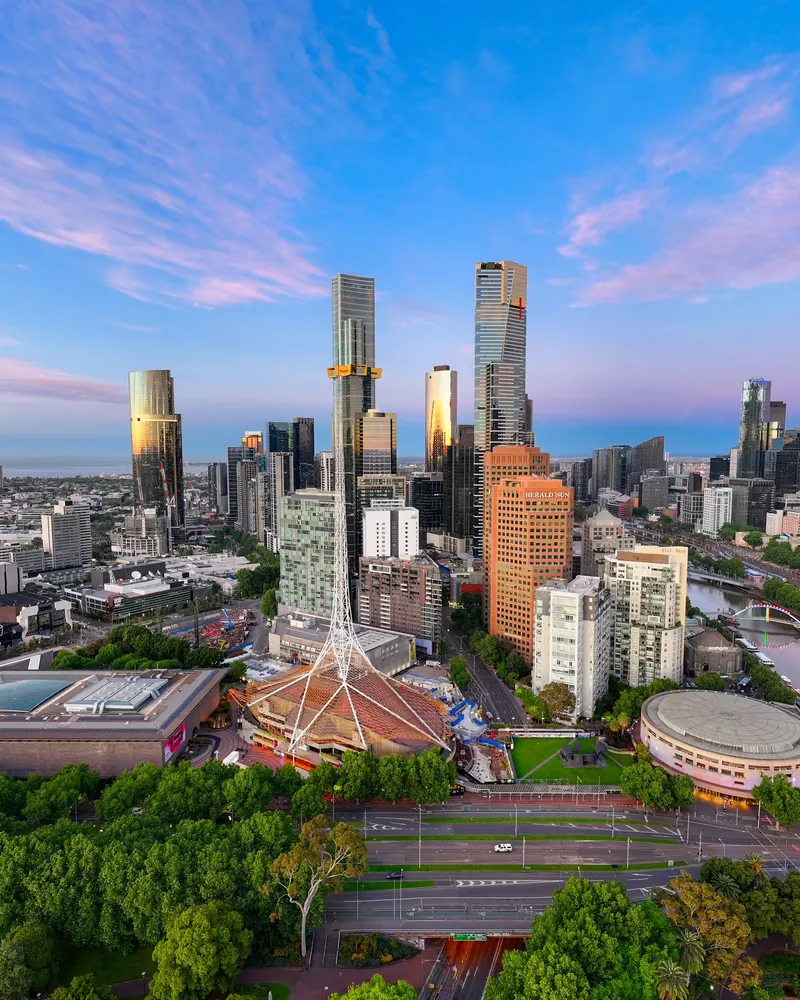
Melbourne's spire, from an angle no one sees.
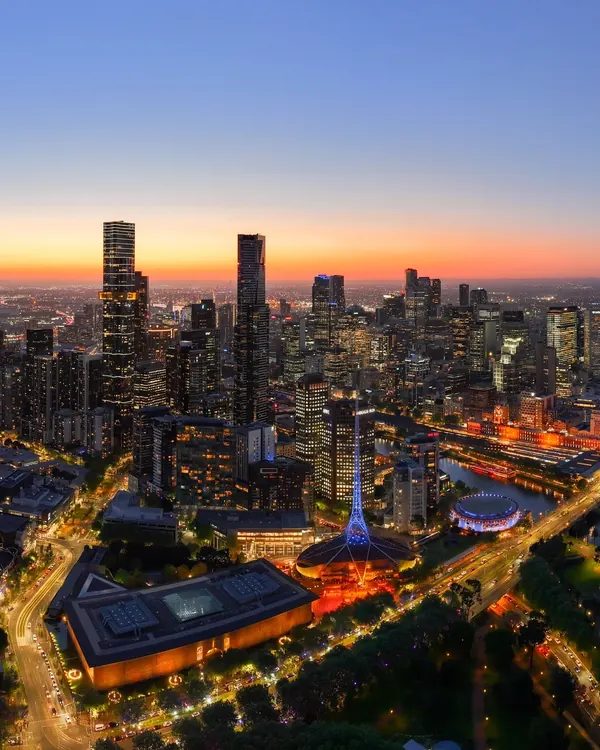
The Arts Centre spire is one of Melbourne's most recognisable silhouettes from the ground — and almost never seen from above. Flown low and tight, this image reveals the lattice steel structure as a piece of geometry in its own right, set against the Yarra and the Southbank arts precinct below. A close, deliberate study of a landmark hiding in plain sight.
- Location
- Southbank, Melbourne
- Altitude
- ~250ft / 76m
- Camera
- DJI Mavic 3 Pro — Hasselblad 4/3 CMOS
- Paper
- Hahnemühle Photo Rag 308gsm
- Available Sizes
- A3 · A2 · A0
- Price
- From A$63 AUD
- Availability
- Printed to order
Questions? Contact me directly about sizes, framing, or custom orders.
The shot
Flown at around 250 feet, considerably lower than the city-wide frames in this collection, and deliberately so. The subject is the spire itself, not the skyline it sits in, and altitude would have turned it into one more object in a wide view of Southbank.
Low and tight means less margin: a tighter composition, a smaller window for the framing to be right, and a structure whose lattice only reads correctly from a narrow band of angles. Everything about the flight was arranged around holding that one position.
A landmark from the one angle nobody uses
The Arts Centre spire is one of Melbourne's most recognisable silhouettes from the ground and almost never seen from above. It is designed to be looked up at — every line of it resolves for a viewer standing on St Kilda Road.
Looked down on, it becomes something else entirely: a lattice of steel resolving into pure geometry against Southbank, with the Yarra and the arts precinct below. It is the closest thing in the collection to abstract art, except that every line of it is real. It is also one of the ten views in Melbourne from above.
What the print shows
The structure reads as a repeating steel pattern that draws the eye inward, with the surrounding precinct providing just enough context to tell you what you are looking at. Take the context away and the image would be a pure abstract; leave too much in and it becomes a postcard of Southbank.
That balance is the reason the frame is close rather than wide. The recognition tends to arrive a beat after the pattern does — people read the geometry first and the landmark second, which is an unusual order for a building this familiar.
Sizing and framing this image
This print is offered in three sizes rather than the full A-series range: A3, A2 and A0. A3 and A2 suit its graphic, close-in composition at short viewing distances — a hallway, a study, or hung as a pair with another print from the collection. A0 turns the lattice into a wall-scale pattern and wants two to three metres of viewing distance.
Because the image is closer to abstract than to landscape, it sits comfortably in interiors where a recognisable skyline would feel too literal. The size guide works the choice backwards from your room, and the framing guide covers mats and frame colour.
Print terms, defined
- Giclée print
- A giclée print is a print made with pigment-based inks rather than dyes, laid down by a large-format printer at high resolution. Pigment inks sit in the paper instead of soaking through it and are rated for well over a century of colourfastness, which is the difference between a fine art print and a poster-shop print that fades visibly in years.
- Hahnemühle Photo Rag 308gsm
- Hahnemühle Photo Rag 308gsm is a 100% cotton rag paper from a German mill that has made paper since 1584. It is matte, heavy and slightly textured, which lets dark tones sit flat and quiet rather than turning the surface into a mirror — the reason it suits city-at-dusk images, which live or die on their shadows.
- Made to order
- A made-to-order print is produced individually once it is ordered — printed, proofed and shipped as a one-off run rather than pulled from warehouse stock. Every print in this collection is made this way and checked against the current printer profile before it ships. They are open prints, not numbered limited editions.
- A3
- A3 is 297 × 420mm (29.7 × 42cm). Like A4 it works at close range and in groups, and it is the low-risk way to live with an image before committing to it at scale. It is one step on the ISO 216 A-series, where each size is half the area of the one above it.
- A2
- A2 is 420 × 594mm (42 × 59.4cm), roughly a movie poster, with a 73cm diagonal. It is the most flexible size on a wall: corridors, home offices, and the wall at the foot of a bed.
- A0
- A0 is 841 × 1189mm (84.1 × 118.9cm), the largest standard A-series size, with a 146cm diagonal. It is a genuine large-format print that wants a dedicated wall and two to three metres of viewing distance.
Common questions
How are these prints made?
Each one is a giclée print: pigment-based inks rather than dyes, laid down by a large-format printer at high resolution onto Hahnemühle Photo Rag 308gsm, a 100% cotton rag paper. Pigment inks sit in the paper instead of soaking through it and are rated for well over a century of colourfastness. Prints are made to order, proofed, and checked against the current printer profile before they ship. The full production process is documented in the journal.
What sizes is this print available in, and what do the dimensions mean?
Melbourne Arts Centre is available in A3 (29.7 × 42cm), A2 (42 × 59.4cm), A0 (84.1 × 118.9cm). Those labels come from the standard A-series, which doubles in area at each step up — A4 is about a magazine page, A2 roughly a movie poster, and A0, at 84.1 × 118.9cm, the largest standard size. Framing adds to all of these — a matted, framed A1 becomes roughly 80 × 105cm on the wall — so compare framed sizes against your space, not paper sizes. The print size guide works the choice backwards from your viewing distance.
How should I frame it?
Matte black is the gallery standard and the safe answer, because it disappears against a dark image rather than competing with it; oak and white both work in the right interior. A mat border of 8 to 10cm keeps the print surface off the glass, which matters over years, and grows the framed piece accordingly. If the wall takes direct sun, choose a matte surface and skip glass-fronted frames. The framing guide covers frame colour, matting, and placement in detail.
How long until it arrives, and where do you ship?
Allow 5 to 7 business days for printing and quality control before dispatch, then 2 to 4 business days to Australian metropolitan areas and up to 7 to regional and remote areas. Shipping within Australia is free and tracked, and prints travel rolled in acid-free tissue inside heavy-duty crush-resistant tubes. Orders currently ship within Australia only. Full detail is on the shipping policy page.
Is this an open or limited edition?
It is an open print, made to order. Prints are not numbered or released in limited editions — each one is produced individually when it is ordered rather than pulled from a pre-printed run held in a warehouse. That also means every copy is checked against the current printer profile on the day it is made.
Where was Melbourne Arts Centre shot?
Arts Centre Melbourne, on St Kilda Road in Southbank, just across the Yarra from the CBD. Flown low and tight at around 250 feet — well below the altitude used for the city-wide frames — because the subject here is the spire itself rather than the skyline around it.