A building living in two eras
333 Collins Street is really two buildings wearing one address. At street level you get the heritage banking facade: ornate stonework, arched windows, the heavy civic confidence Melbourne's architects reached for in the late 1800s, when gold money had briefly made this one of the richest cities on earth. Above it rises a standard-issue office tower from the early 1990s, glass and steel like its neighbours.
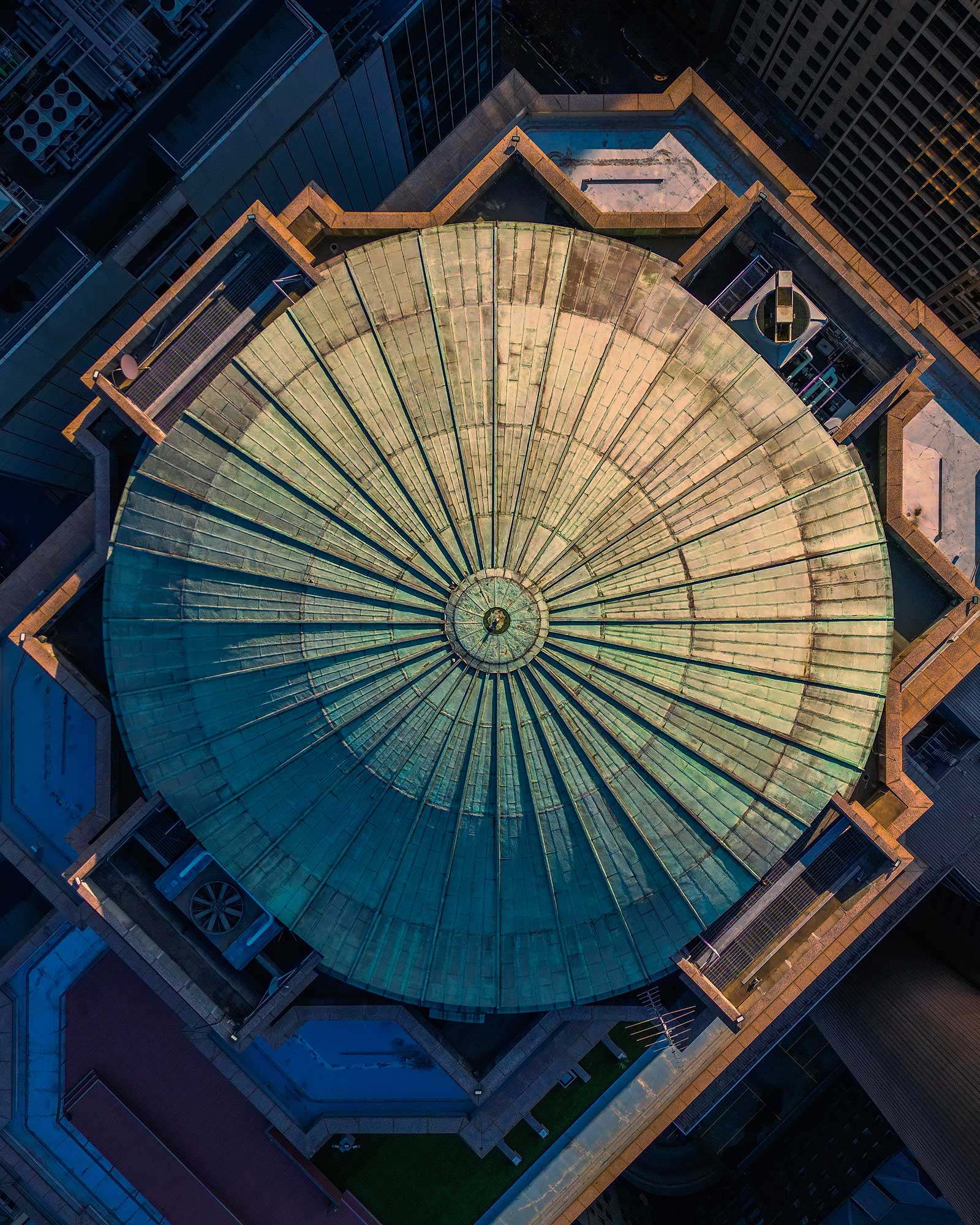
Where the two eras meet sits the copper dome. It's not decoration; it's the hinge of the whole composition, mediating between the curved, human-scaled heritage forms below and the hard right angles of the tower above. From the footpath you can just catch the crown of it, if you know where to look. From 400 feet directly overhead, it becomes something else entirely.
What you see from 400 feet that nobody was meant to
Buildings are designed for the pedestrian view. Proportions, ornament, the way a facade meets the street, all of it is calibrated for someone walking past. Nobody briefed the architect on the nadir view, which is exactly why it's interesting: it shows you geometry the building never intended to perform.
Straight down, the dome reads as a perfect circle inscribed in a rectangle. The copper has weathered to a green-brown patina that never photographs the same way twice, and at altitude you can finally see its texture: individual panels, seams, the slight swell of each section that gives the structure its strength. The CBD grid frames it on every side, and all that hard orthogonal geometry makes the curve more emphatic, not less.
The heritage stonework that dominates the street view shrinks to a thin border. The tower vanishes completely. At 90 degrees nadir you're looking at the podium roof, and the tower is behind the camera. What's left is the dome, a ring of 19th-century stone, and Collins Street running past. It makes you reconsider what the building actually is.
Gold rush banking and the "Paris end"
Collins Street's elegance gets called Parisian, but the money behind it wasn't. This precinct was built by the banks that handled Melbourne's gold wealth from the 1850s through to the 1890s crash, and their buildings were arguments in stone: domes, columns, and mass that said permanence to a city that was decades old and growing too fast to believe.
The grand banking chamber under the dome at 333 Collins survives, though it now hosts weddings and corporate functions rather than tellers. Most guests never learn the history standing above them. The architecture keeps the record anyway.
From the air, the same ambition reads differently. These were buildings designed to stand against the sky and mean something. The dome was always meant to be seen, just never from above.
Why it works as a print
The standard Melbourne aerial (CBD at dusk, the Yarra bend, the bay behind) is a lovely image that hangs in half the offices from Docklands to Southbank. The overhead view of the 333 Collins dome does something different. It's a close, specific observation of a building people already know, from an angle nobody uses.
When someone sees the print in person for the first time, there's usually a pause, then: "Wait, is that what I think it is?" That moment of recognition is the whole point. The image rewards a second and third look, the panel seams, the shadow line, the way the street grid frames the circle, which is what separates a piece you live with from a piece you stop noticing.
It's also why this image ends up in Melbourne boardrooms. For a business that belongs to this city, a landmark every client recognises, seen the way none of them have, says more than any generic skyline.
The 333 Collins Street Dome print is available in sizes from A4 to A0, on Hahnemühle Photo Rag.
View the Print