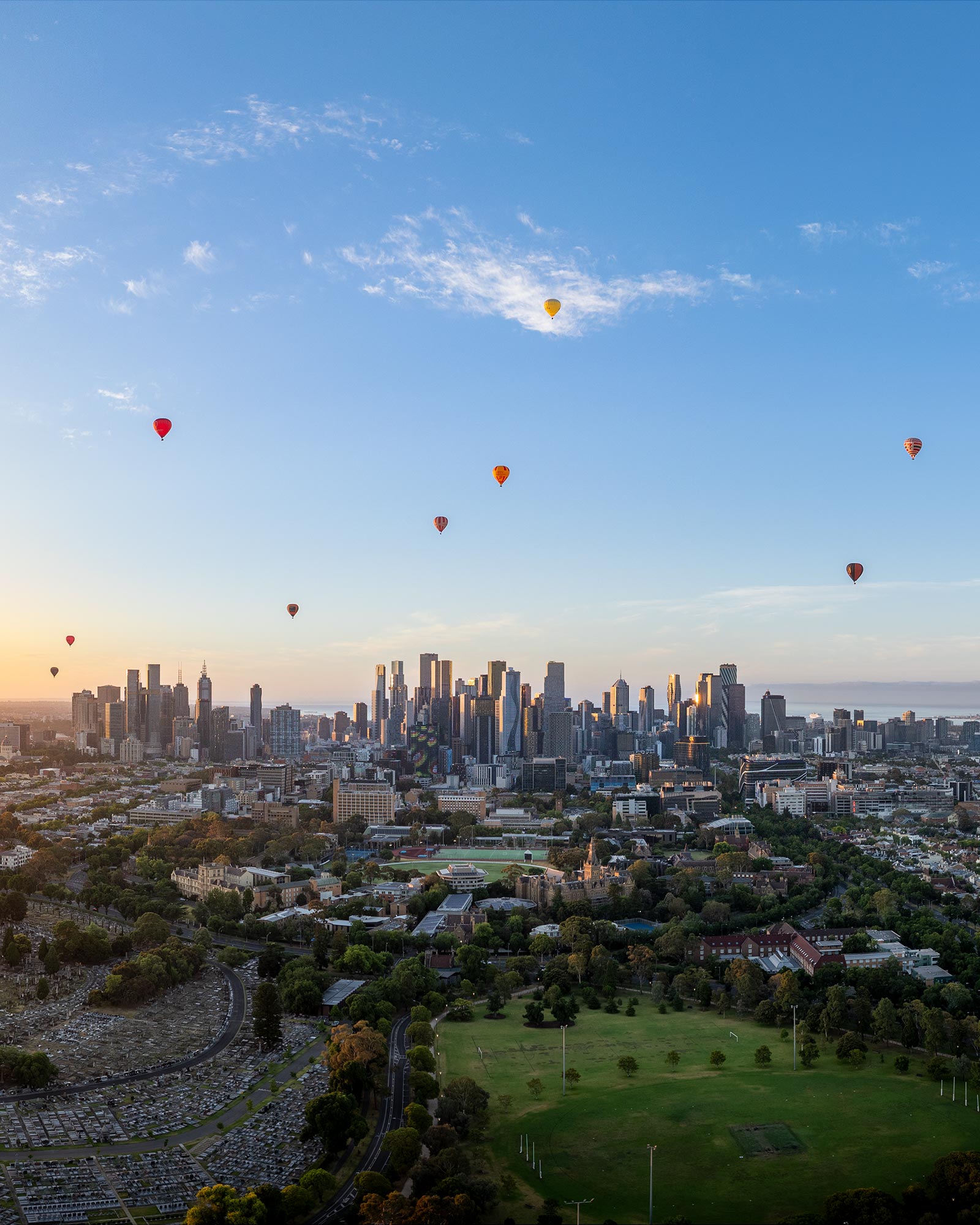
Why the balloons are so hard to photograph from the air
Melbourne is one of the only cities in the world where commercial hot air balloons fly directly over the CBD. Most mornings in the cooler months, if the wind behaves, you'll see them drifting somewhere between Flagstaff Gardens and the Yarra around first light.
The catch is in that phrase: if the wind behaves. Balloon operators only launch in light wind, clear sky, and stable air. The exact same calm that lets them fly tends to come with a low-level inversion that traps haze over the city and flattens the light. So the mornings you can fly are very often the mornings not worth flying.
Timing makes it harder again. The operators launch around civil twilight, about 5:45 to 6:15am in winter, and the whole flight lasts roughly an hour. The stretch where the balloons are aloft and the sun is low enough to give you proper colour is about twenty minutes. Miss it and you've got balloons against a washed-out sky.
I tried four times over two winters. One of those flights produced a print. The other three produced cold hands and a lesson each.
Reading the weather window
The conditions for this shot are stricter than what either the balloons or the drone need on their own. Wind under 10 knots at the surface and under 15 at altitude, or the drone footage gets rough even when the balloons are happy. Visibility past 10km with no cloud below 2,000 feet, because cloud at 1,500 feet, a Melbourne winter staple, sits right in the balloon launch zone and grounds them.
The inversion is the subtle one. A strong inversion turns the skyline milky and grey from altitude. A weak one actually helps: it holds the propane burner plumes in short visible wisps that give the photo life. The morning that worked had thin, high cirrus to the west and clean colour to the east. You can't order that. You can only keep checking.
My routine the night before is BoM's gridded wind data at surface, 900hPa and 850hPa, cross-checked against the ECMWF model in Windy. If the 6am model and the latest observation agree, the alarm gets set for 4:30. This routine eventually became the Flight Check tool, because I got tired of doing it by hand.
Be in the air before they are
The single biggest lesson from the failed attempts: launch first, wait at altitude. If you wait until you see the balloons go up, you'll burn the first ten minutes of battery climbing while they're at peak height, and by the time you're in position they're already coming down.
For the shot that worked, I launched from a park north of the CBD at 5:20am and was holding at around 100 metres by 5:35, watching an empty sky. The balloons came up at 5:52, just as the pre-dawn indigo started going gold at the horizon. It was -8°C that morning, which knocks roughly 12% off the Mavic 3 Pro's rated battery life. Two batteries, one ground swap, about 75 minutes of total flight time, all of it for a twenty-minute window.
What sunrise does to Melbourne's glass towers
In the first half hour after sunrise, the CBD's east-facing glass acts as a field of mirrors. At five degrees of solar elevation a tower facade throws back a near-white flash; by twenty degrees it's just glass again. The Collins Street towers, all facing slightly different directions, flicker in and out of reflection as the angle shifts minute by minute.
The balloons want the same window. Slightly backlit, you get the envelope fabric reading in silhouette and the burner flashes registering warm orange against a cool sky. Balloons at mid-altitude, low sun, and towers catching first light all have to line up at once, and that only happens on the right morning.
The print
The final image, Floating Over Melbourne, was shot from close to 400ft, at the top of the standard altitude ceiling for this kind of flight. From up there the balloons sit in the lower quarter of the frame and become a scale reference: objects of known size against the CBD grid, the Yarra to the south, the bay just visible past Port Melbourne.
A city that feels dense and compressed at street level turns out, from above, to be a handful of objects in an enormous amount of space. That's what I wanted on the wall.
If you're weighing up sizes or thinking about how a print like this works in your space, the framing guide covers sizing and placement in detail. Or email me and I'll help you choose.
Floating Over Melbourne is available as an archival giclée print, in sizes from A4 to A0.
View the Print