What "A0" actually means for wall art
A0 is the largest standard paper size: 841 × 1189mm, call it 84 × 119cm. When people search for "large wall art Melbourne," this is usually the scale they have in mind. My prints come in the standard A-series sizes leading up to it: A4 and A3 for desks and shelves, A2 (42 × 59.4cm), A1 (59.4 × 84.1cm), and A0 itself.
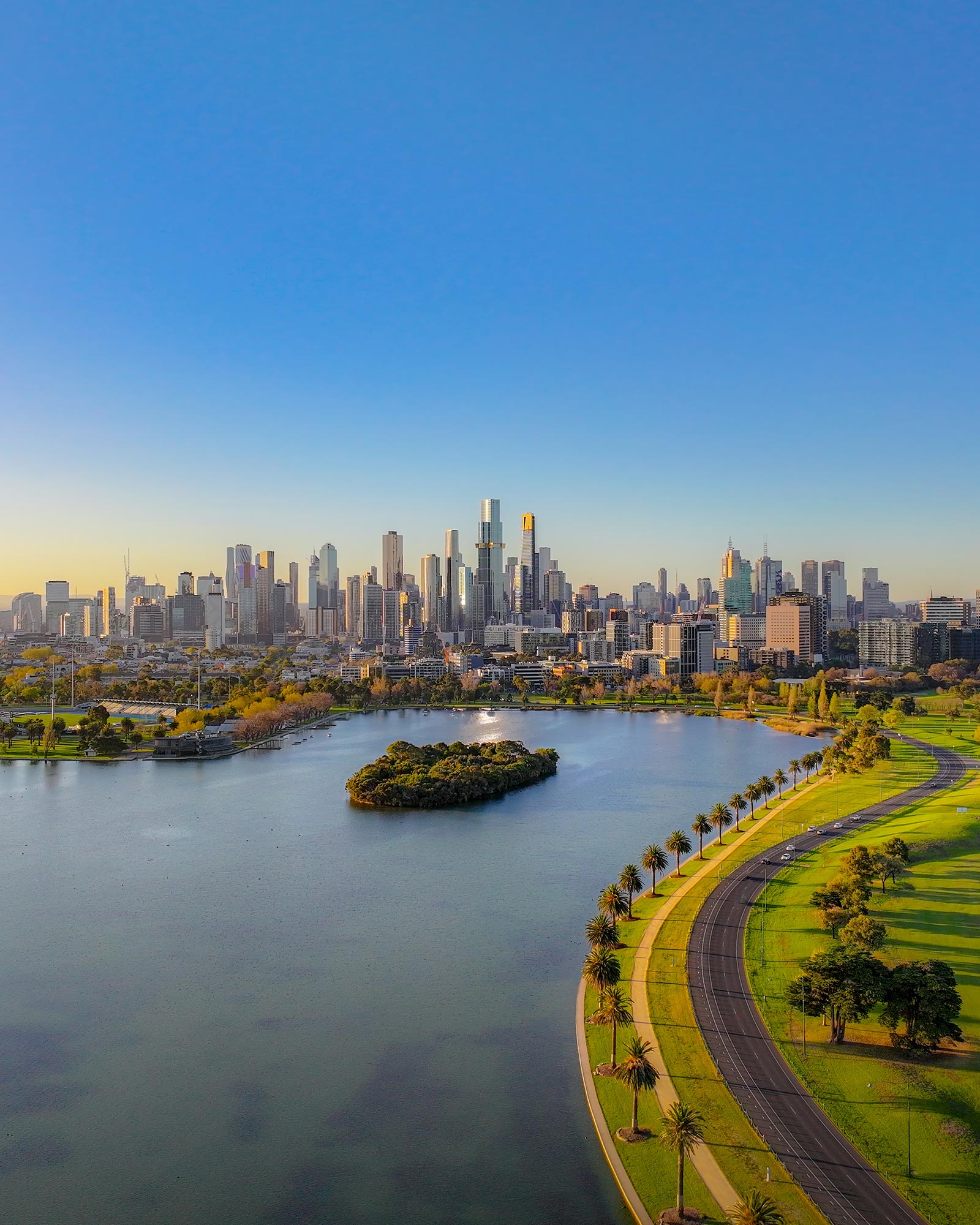
For most Melbourne apartments, A1 is the sweet spot. It anchors a room without swallowing it. A0 is a genuine statement piece for a dedicated feature wall, and at that scale the photography starts giving back detail the smaller sizes can't. In the Albert Park Sunset print you can pick out individual boats moored in the lake's eastern corner.
Measure the wall before you choose the size
Apartments built in Melbourne since about 2000 mostly have 2.4 to 2.7 metre ceilings. That sounds like plenty until you subtract skirting, furniture clearance, and breathing room at the top. The workable hanging zone is usually 1.8 to 2.1 metres. An A0 print hung portrait is nearly 1.2 metres of paper before you add a frame and mat — under a 2.4m ceiling that's most of the zone gone. Landscape orientation is the escape hatch.
Width matters just as much. A large print wants 40 to 50cm of clear wall on either side. The same A0 print that looks deliberate on a 2.4m wall looks wedged-in on a 1.2m one.
And check which way the wall faces. South-facing walls get diffuse, even light all day, which is ideal for photography. East and west walls take direct sun at the ends of the day, which means glare on glass and washed-out shadow detail. If your best wall cops direct sun, go matte surface and skip glass-fronted frames.
Frame choice: black, oak, or white
Aerial photography of Melbourne runs dark: near-black water, charcoal CBD grid, deep blue dusk. That built-in contrast means most frame choices work; it's a question of what you want the frame to do.
Matte border or borderless?
A matte border (the mat, or passepartout) isn't just styling. It keeps the print surface off the glass, which matters over years, since paper in contact with glazing can stick and mark. For fine art photography the standard treatment is a generous 8 to 10cm border, which also grows the framed piece: an A1 print (59.4 × 84.1cm) matted becomes roughly 80 × 104cm on the wall, and reads accordingly.
Borderless ("full bleed") mounting is more contemporary and suits images with a strong compositional edge. For my prints I'd reserve it for the A0 size, which has the scale to hold a wall without the visual expansion a mat provides.
If you're framing in Melbourne, any custom framer in Fitzroy or Collingwood can do archival matting well. Ask specifically for acid-free mat board and spacers. For float mounting on standoffs, bring the wall type (plasterboard vs masonry) into the conversation early.
A worked example: Albert Park Sunset in a bedroom
Say you're hanging the A0 Albert Park Sunset (84 × 119cm) in a bedroom with a 2.6m ceiling. Centre the print at eye height, about 155 to 160cm off the floor, which puts the bottom edge near the metre mark, clear of bedside furniture. A matte black frame with a 6cm off-white mat takes the finished piece to roughly 96 × 131cm.
Opposite the bed, with two to three metres of viewing distance, that's the dominant object in the room. And unlike a screen, archival paper changes with the room: the lake reads differently under morning window light than it does under a warm lamp at night. That slow shift is most of the reason to own a print rather than look at the same image on a phone.
Not sure which size suits your wall? Send me a photo of the space with rough measurements and I'll give you an honest recommendation, including "go smaller" if that's the right call.
Prints come in standard sizes from A4 up to A0 on Hahnemühle Photo Rag 308gsm.
Browse Prints