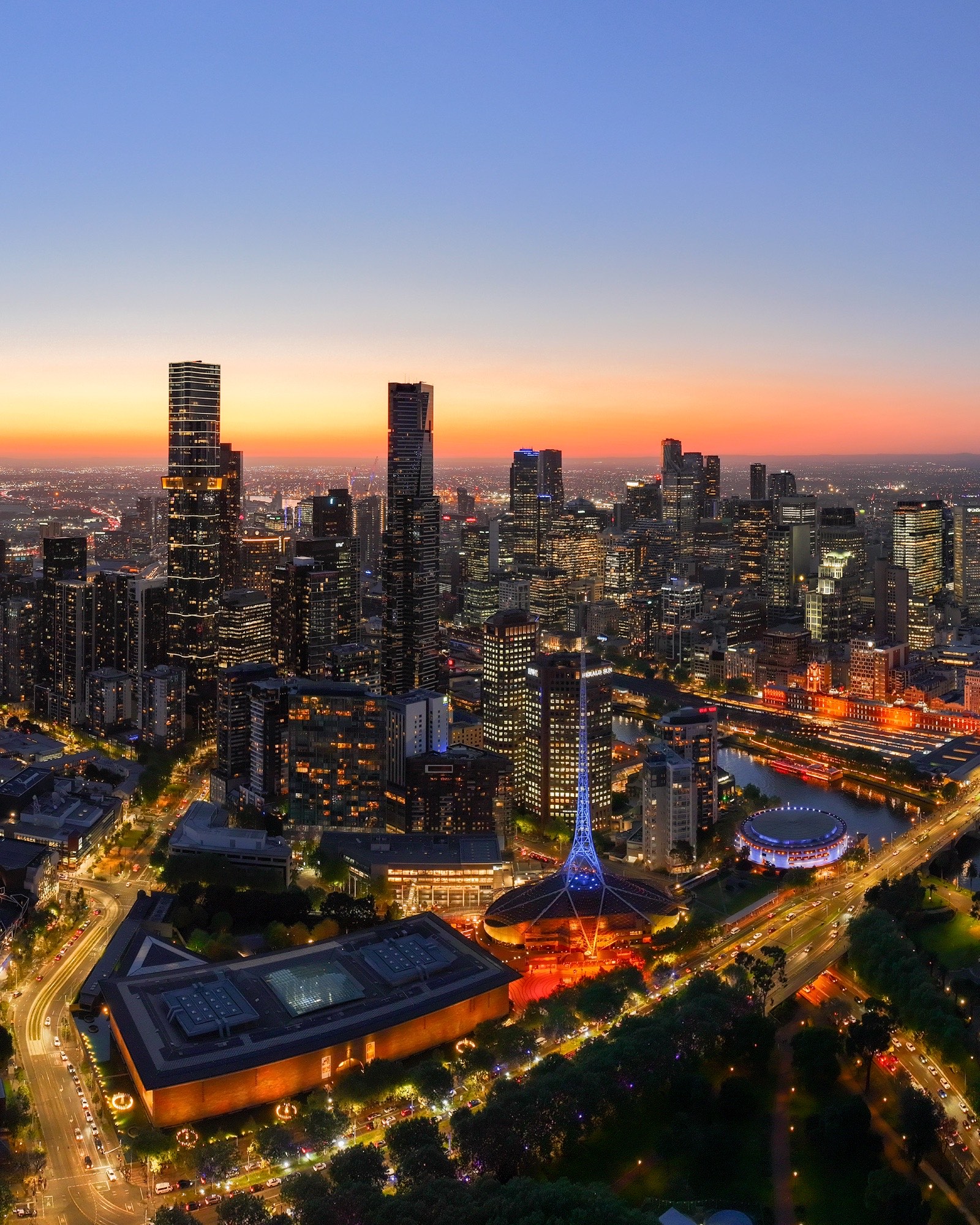
The window
Photographers call it blue hour, which oversells it by about 56 minutes. After the sun drops, there's a stretch where the sky holds deep colour while the city's lights come up to meet it. The balance point, where a tower's windows glow warm against a sky that still reads blue rather than black, is brutally short. In Melbourne in late autumn, when this was shot, it runs roughly from 18 to 22 minutes after sunset. Before it, the sky wins and the city looks dim. After it, the sky goes black and you're shooting a postcard.
The image had to catch that handover exactly. Which meant the drone had to already be in position, composed, focused, and settled before the window opened. You don't find this shot at dusk. You reserve it in the afternoon.
Three failures first
Attempt one: forecast said clear, and it was, except for a band of cloud parked precisely on the western horizon that swallowed the afterglow. The sky went from grey to black with no blue in between. Attempt two: wind. Fifteen knots gusting twenty-five at altitude, and while the drone can fly in that, long exposures can't survive it and neither can exposure stacking. I flew, shot, went home, and deleted everything. Attempt three was the stupid one: everything perfect, and a low battery warning at the exact wrong moment because I'd burned too much of it repositioning early. The drone was landing during the four minutes it existed to photograph.
People sometimes ask why a print costs what it does when "the drone does the work". The drone attended four evenings for this image. It did not do the work.
The evening it worked
Fourth attempt: a cold, still evening after a front had passed through and scrubbed the air clean. Haze is the quiet killer of city photography, and post-frontal air in Melbourne is the clearest you'll ever shoot in. Launch position scouted on the earlier failures, drone up 40 minutes before the window, composition locked with the CBD grid running diagonally through frame so the eye enters at Southern Cross and exits into the dusk.
Then the wait, hovering, watching the histogram as the balance shifted. When it tipped, I shot stacked exposures continuously for the whole four minutes: several frames captured seconds apart, the drone holding position to the centimetre, later combined into one file with clean shadows and no noise in that deep blue. Forty-plus frames for one photograph. The stillness of that evening is why the print's sky looks the way it does at A0, smooth as poured ink, with no grain pretending to be texture.
What the image is actually of
Everyone photographs Melbourne's skyline from the ground, across the river, from a rooftop bar. At 400 feet the city stops being a silhouette and becomes a field of light. You're not looking at the buildings; you're looking down the streets between them, the grid reading as glowing canyons, the whole CBD resolving into the geometry that Hoddle laid out in 1837 and that's invisible from footpath level. That's the thing I wanted: the moment the city's plan becomes visible, held in the last minutes of a blue sky.
A good twilight is less repeatable than people assume. Same location, same settings, different evening: different photograph. This one is printed to order on archival cotton rag, which feels right for an image whose subject lasted four minutes.
Melbourne City Twilight is printed to order on Hahnemühle Photo Rag.
View the Print