It starts with a shot list and a forecast
Most images in the collection existed as an idea months before they existed as a file. I keep a running list of Melbourne subjects with notes on the conditions each one needs: wind under 15 knots for long exposures, a north wind to clear the haze, cloud at the right height to catch colour. Then it's a waiting game. The balloon shot took a season of 4am false starts before the morning that worked.
The flight itself is short and unglamorous. Batteries give a practical 25 minutes, the light window at dawn or dusk is often shorter, so positions are planned before launch and the drone flies a route rather than a search. At 400 feet over the CBD there's no time to wonder what the photo should be.
The file, and why it matters for print
I shoot RAW on a Hasselblad-tuned 4/3 sensor, which sounds like marketing until you print big. An A0 print enlarges the file to many times the size of this screen. At that scale, sensor quality stops being a spec and becomes visible texture: noise in the dusk sky, or clean gradation; mush where the water should have detail, or individual boats on Albert Park Lake. The camera was chosen for the biggest print size, and everything smaller inherits the headroom.
For twilight images, the technique that matters most is stacking: several exposures captured seconds apart while the drone holds position, later combined for a cleaner, deeper file than any single frame. A drone that can hover motionless at dusk is what makes this possible at all.
Editing is decisions, not filters
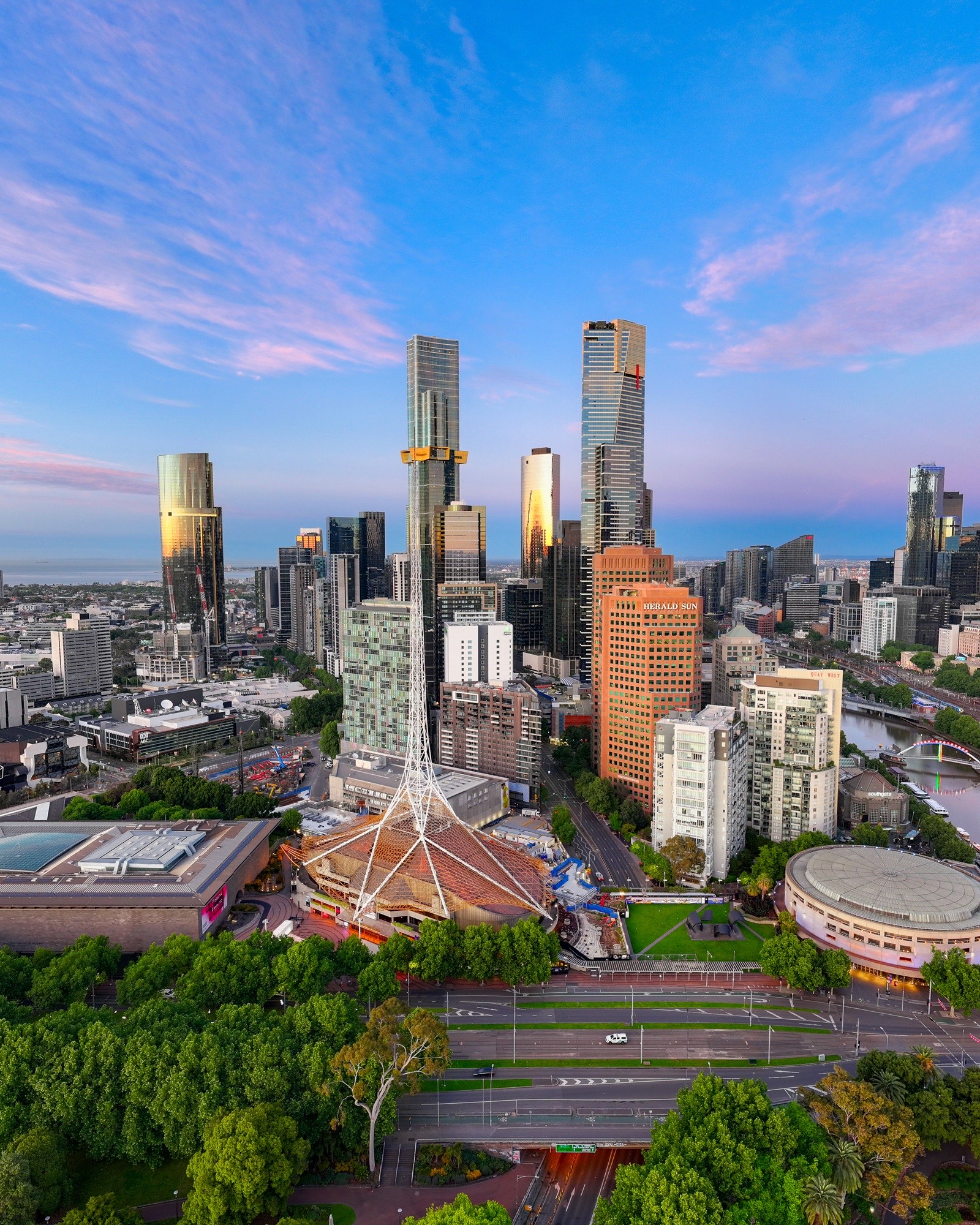
My editing rule for prints is simple: enhance what was there, add nothing that wasn't. The sky in Melbourne City Twilight really was that blue; twilight does it for about four minutes and the file just has to survive it honestly. What editing actually involves is slower and duller than people imagine. Correcting lens geometry so the towers stand straight. Balancing the mixed light sources a city throws at dusk, sodium orange against LED white. Local contrast work so the print reads properly at viewing distance, which is different from reading well on a phone.
Then a proof cycle: test strips printed, checked under warm and cool light, adjusted, reprinted. Screen and paper never fully agree, and the paper wins the argument because the paper is the product.
Giclée, Hahnemühle, and what the jargon means
Giclée is a fancy word for a precise thing: pigment-based inks, not dyes, laid down by a large-format printer at high resolution. Pigment inks sit in the paper rather than soaking through it, and they're rated for well over a century of colourfastness. Dye prints from a poster shop fade visibly in years; that's the entire difference, and it's why one costs more.
The paper is Hahnemühle Photo Rag, 308gsm, a 100% cotton rag stock from a German mill that has made paper since 1584. It's matte, heavy, and slightly textured, and it does something to aerial photography that gloss papers don't: it lets dark tones sit flat and quiet instead of turning into a mirror. City-at-dusk images live or die on their shadows, so the paper choice isn't aesthetic preference; it's structural.
Why prints are made to order
Every print is produced individually when it's ordered — printed, proofed, and shipped as a one-off run rather than pulled from a stack in a warehouse. I get asked why I don't pre-print and hold stock. The honest answer: each order gets checked against the current printer profile before it ships, and making each print on demand forces the discipline of releasing only images I'd happily put my name on again tomorrow. That filter kills far more images than weather ever does.
From flight to finished print, the process above takes weeks at minimum. The result is a physical object made from a few minutes of Melbourne light that won't repeat. That's the whole product.
Every print in the collection is made exactly this way, to order, on archival cotton rag.
Browse the Collection